Featured Artifacts

Enter the World of the Ancient Gladiator
Step into the arena of ancient Rome — a world of thunderous crowds and ritual combat, where gladiators stood at the center of one of history’s most powerful public spectacles. Far from being mere victims or entertainers, many were elite professionals: trusted bodyguards of rulers, disciplined members of private schools bound by fierce loyalty, and performers whose fame and earnings could rival those of celebrated mega athletes today.
What began as sacred contests held to honor the dead — blood offerings believed to strengthen bonds between the living and those who had passed — grew into spectacles that reshaped Roman public life. Gladiators came from many worlds: prisoners of war, volunteers seeking fame, skilled professionals loyal to their training schools, and, at times, even women and members of the ruling class drawn into the arena’s powerful allure. The games expanded far beyond single combat, filling vast amphitheaters with staged naval battles, confrontations with exotic beasts, displays of horsemanship, and elaborate reenactments that transformed violence into theater on a monumental scale.
Gladiators fought with lethal precision, their skill forged through harsh training and the constant risk of death before thousands of spectators. Although most were enslaved and forced into combat, they were among the most capable fighters in the ancient world. In 73 BCE, a gladiator named Spartacus turned those skills against Rome itself, leading a rebellion that defeated powerful Roman legions and sent fear through the Republic. For a brief moment in history, an army of former slaves came close to unraveling the social order upon which Roman power depended.
Wiithin the same amphitheaters, condemned prisoners and early Christian martyrs faced death before the crowd, embracing their fate with a devotion that ancient writers sometimes compared to the oath of the gladiator — a willingness to surrender one’s life publicly for honor, belief, or faith. Thus the arena became not only a stage of combat, but a place where power, suffering, and belief were revealed before Rome itself.
This museum explores that world through artifacts, reconstruction, and historical interpretation — revealing the equipment, traditions, and human stories that defined the gladiatorial experience and ensured its lasting place in history.
The Gladiators
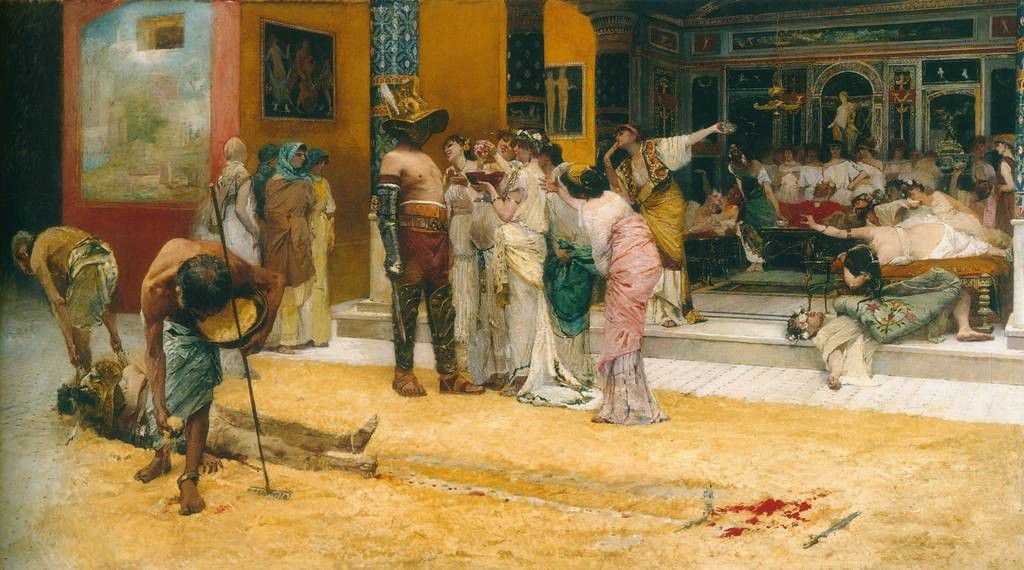
Gladiators were not a single class of men, but individuals drawn from many worlds — bound by oath, distinguished by skill, and defined by the roles they embodied in the arena. Explore the lives, training, and equipment that forged them into Rome’s most formidable combatants.
The Arenas
The arena was a precisely organized institution of performance, danger, and display. Within vast amphitheaters, carefully staged events unfolded — duels, hunts, reenactments, and spectacles that transformed violence into public ceremony.
Roman Society
From rituals honoring the dead to displays reinforcing imperial authority, the arena became a mirror of society itself. Examine how combat, belief, politics, and public identity converged in one of Rome’s most enduring institutions.
Forms of Arena Spectacle
Public events that extended beyond single combat. Structured duels between trained fighters existed alongside staged hunts, engineered reenactments, and judicial displays that reflected the legal and cultural order of the time..




Exploring the World of the Roman Arena
The arena brought together fighters, spectators, architecture, and spectacle in one of Rome’s most influential public institutions. Each element reveals a different dimension of life, power, and performance in the ancient world.
01
Gladiator Types
Distinct classes of gladiators were defined by specific arms, armor, and combat roles. These structured pairings created contrast in the arena while reflecting Roman ideas about discipline, identity, and martial skill.
02
Training & The Ludus
Gladiators trained within organized schools under experienced instructors who enforced strict discipline and hierarchy. Life inside the ludus combined physical conditioning, tactical instruction, and an oath binding fighters to the risks of the arena.
03
Armor & Armaments
Helmets, shields, and weapons were carefully designed to balance protection with visibility and mobility. Each configuration shaped fighting style, pairing, and strategy, making material culture central to the structure of combat.
04
Amphitheatres & Architecture
Roman amphitheatres were engineered for visibility, crowd management, and staged spectacle. From subterranean passageways to tiered seating, their design reveals how architecture supported performance and public order.
05
Spectacle & Public Events
The arena hosted more than duels, encompassing staged hunts, reenactments, and judicial displays. These events blended entertainment, ceremony, and authority within a carefully organized public setting.
06
Rome, Power & Belief
The games reflected the social and political fabric of Roman civilization. Ritual origins, imperial patronage, and public response shaped how the arena expressed authority, loyalty, and collective identity.
Free Resources from the Museum Archive
The museum offers a selection of downloadable resources inspired by the world of the Roman arena. These materials are freely available to visitors interested in studying, illustrating, or recreating elements of gladiatorial history.
Martyrdom in the Roman Arena
The Roman arena also served at times as a site of judicial execution. Some early Christian communities understood martyrdom as a path to eternal reward, and surviving accounts portray certain individuals meeting death with visible composure or even resolve.
Writers described these moments using language of contest and victory, transforming the arena — intended to display Roman authority — into a setting where faith was publicly affirmed rather than denied.
Main
About
Products
Blog
© 2026 Museum of the Ancient Gladiator. All rights reserved.